- Front shell
- 57.4 cm³ · 100 × 76 × 61
- Rear bezel
- 10.3 cm³ · 10 × 76 × 61
- Grip
- 46.8 cm³ · 37 × 30 × 90
- Grip cap + trigger
- 4.3 cm³
- Window ring
- 0.8 cm³ · holds a 25 × 2 mm fused silica window
- Total plastic
- ≈ 120 cm³ · ≈ $33 MJF nylon · ≈ 148 g PLA
- Hardware
- M2 screws (camera; bezel and screen into shell posts), M3 (grip, NANO), Ø2 mm trigger pin, ¼-20 heat-set insert
Cassvision
A handheld lo-fi video camera in the spirit of Pixelvision
Cassvision is a handheld digital video camera made for Cass’ 50th birthday weekend on Fire Island in April 2027. It takes its cue from the Fisher-Price PXL-2000 (Pixelvision): it isn’t a modern camera with a filter applied afterward, but a purpose-built lo-fi appliance. Pick it up, pull the trigger, and it records.
The image is 160x120 at 15 fps, processed live and shown on a rear screen. It is never shown as square pixels: an analog-style reconstruction stage, standing in for the original’s tape, composite video and CRT, smooths each line horizontally and keeps the lines distinct vertically, with soft scanlines. The look is automatic: poster banding, split tone, colour lag, sound-driven slitscan and glitch bursts, with an occasional Rutt-Etra SCAN that comes and goes on its own. Clips are written straight to microSD as power-loss-safe MP4s that import into iPhone Photos, and come off the camera over USB-C as a plain drive. No app and no WiFi.
The case
The 3D model at the top is the printable enclosure: six parts shown exactly as exported from the CAD script, including a ring that holds a fused silica window in front of the lens to keep beach sand out. Drag to turn it (or switch off Turntable), drag the explode slider to see how the parts go together, pick a part to see it alone, and turn on X-ray to see the electronics inside. The screen runs the camera’s own C image pipeline, compiled to JavaScript, on each frame of a raw clip. Turn on Sound to hear the clip and let it drive the look; Scan now shows a Rutt-Etra visit; Colour switches to black and white like the original.
Electronics
The brain is a Waveshare ESP32-P4-NANO: an ESP32-P4 with 32 MB of PSRAM, a MIPI camera interface, a hardware ISP and H.264 encoder, and a microSD slot, on a 50 mm square board. It takes an OV5647 camera and a 2.4-inch 320x240 screen, exactly twice the image in each direction.
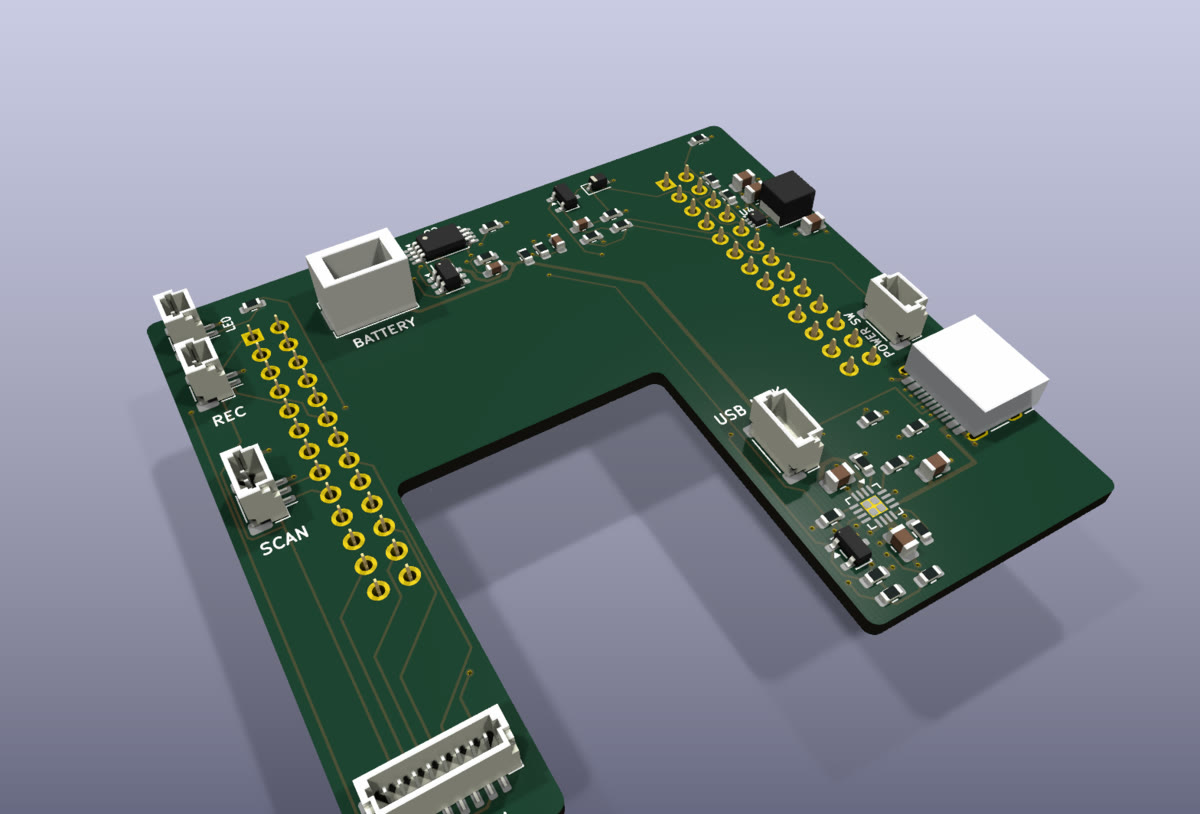
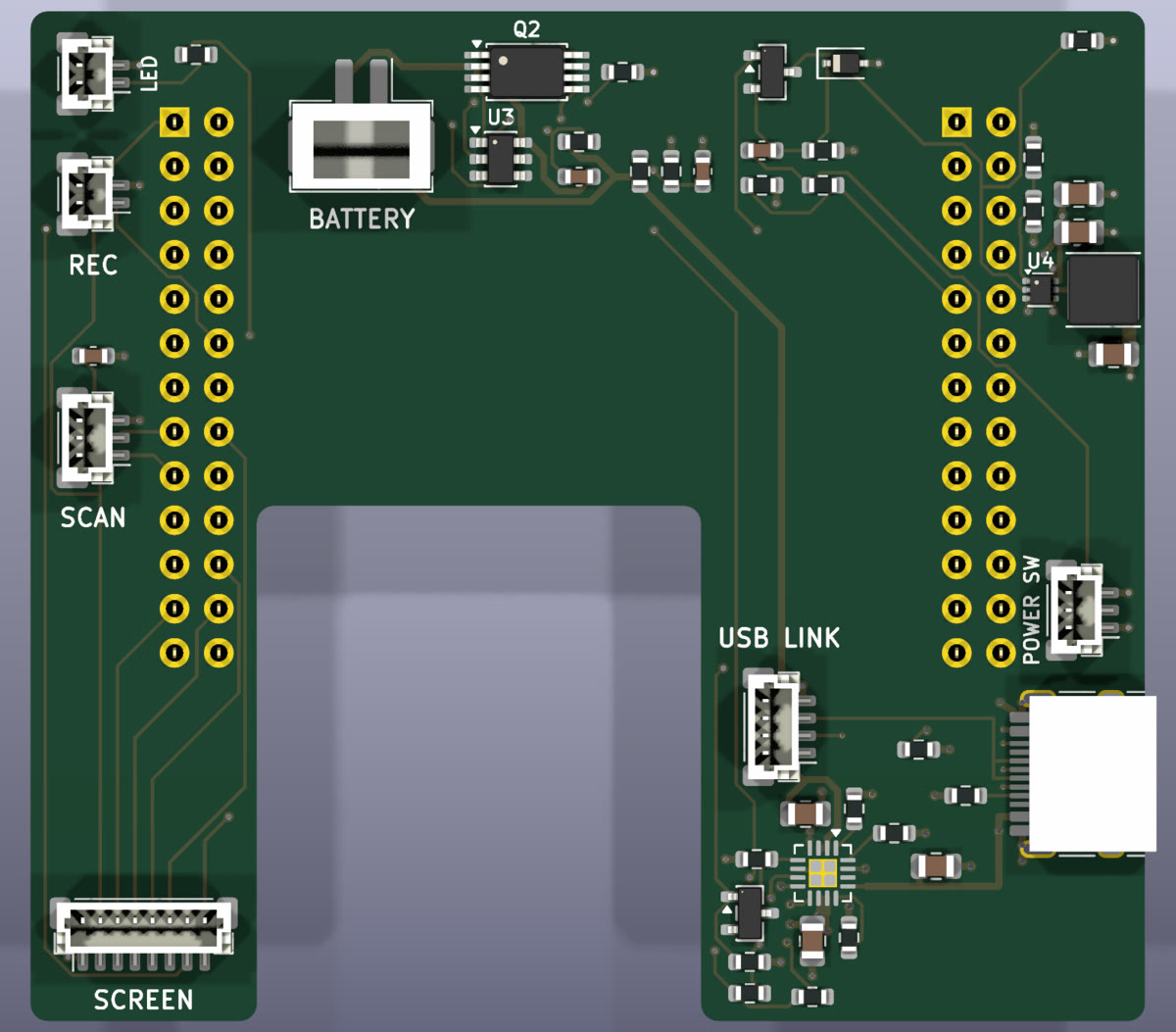
The NANO plugs into a custom four-layer carrier board that turns a dev board into a camera: USB-C charging with power path (it keeps running while it charges), a 5 V boost from the 18650 cell in the grip, soft power with a latch so switching off closes the clip cleanly, a battery gauge, and plugs for the screen, the REC trigger and the LED. The notch at the rear clears the NANO’s Ethernet jack and USB-A port.
Form
A camera you look at instead of through: a rear-screen body with a pistol grip, shaped like a Super 8 camera and kept as small as its parts allow.
How you shoot
Hold it out at chest or face height, like a Super 8 camera, and watch the screen on the back. Your index finger pulls the trigger to record. It is the most obvious way to use a camera you look at instead of through, so someone who has never seen it can pick it up and shoot.
What sets the size
The parts, and nothing more: the 2.4-inch screen and its board set the rear face, the P4-NANO and the carrier lie flat in the floor with the camera standing at the front, and the grip is shaped around one 18650 cell. Print cost follows size, so it is as small as they allow.
Grip
90 mm, raked back like a Super 8 handle (the Canon 514XL kept its batteries in the grip too). The REC trigger sits at its top front; the cap closes the battery bay and carries a ¼-20 tripod insert.
Controls
The REC trigger, and a power slide switch on the right side beside the USB-C port (charging, and the drive the clips come off). The look is automatic, so there are no knobs and no menus.
| Body (L × H × W) | 82 × 61 × 76 mm |
|---|---|
| With lens and grip | 106 × 153 mm |
| Screen | 2.4" 320×240 IPS, exactly twice the 160×120 image, glass standing 1.5 mm proud of the bezel |
| Lens window | 25 × 2 mm fused silica in the barrel, under a ring with two M2 screws |
| Printed parts | Front shell, rear bezel, grip, grip cap, trigger, window ring: about 120 cm³ of MJF nylon |
Reference cameras: the Fisher-Price PXL-2000 and the Canon 514XL-S.